

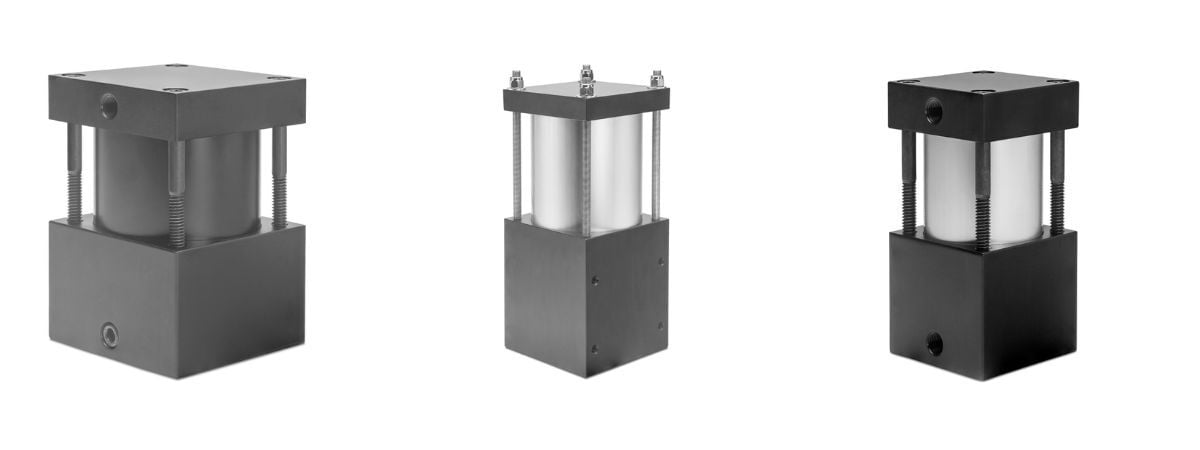
Proper sizing of an air over oil intensifier ensures reliable brake and clamping performance. Engineers often struggle with the two critical factors: balancing pressure amplification and fluid displacement.
This guide provides a direct, step-by-step method to select the right intensifier ratio and displacement volume for your application.
Measuring Pressure Ratio and Displacement
Air over oil intensifiers convert standard shop air (80-100 psi) into higher hydraulic pressures without a full hydraulic system. The pressure ratio is determined by the size difference between the pneumatic and hydraulic pistons.
- A 10:1 intensifier uses a pneumatic piston area 10 times larger than the hydraulic piston area. 100 psi of shop air produces 1,000 psi of hydraulic pressure.
- Fluid displacement is the inverse: The same 10:1 intensifier displaces a volume of fluid 10 times smaller than the air cylinder stroke.
This inverse relationship is the core trade-off in intensifier selection: greater pressure gain means less volume displaced when all other factors are equal. A change in stroke or bore size will allow variability in fluid displacement and overall size of the intensifier. Branham offers ratios from 5:1 to 36:1.
Step 1: Calculate Required Fluid Displacement
First, determine the hydraulic fluid volume your device needs to fully engage. For brake applications, calculate the volume required to move the calipers.
You must know the piston diameter and stroke length. Use this formula:
- Displacement volume = π × (piston radius)² × stroke length
Example: A hydraulic brake has a 1-inch piston diameter (0.5-inch radius) and a 0.25-inch stroke:
- 3.14159 x (0.5)2 x 0.25 = 0.196 cubic inches per piston
If the brake has two pistons, the total required displacement is 0.392 cubic inches.
Match this requirement to available intensifier displacement ratings. Branham's smaller intensifiers (INT05, INT10, INT20) provide 0.44 to 0.50 cubic inches per stroke. The larger intensifiers (INT09, INT18, INT36) deliver 1.77 to 7.068 cubic inches per stroke, depending on the model. The INT05 or INT10 would provide the needed cubic inches in this example.
Step 2: Match Pressure Requirements to Ratio
Once you confirm adequate displacement, select the ratio that produces your required output pressure. Get the minimum required hydraulic pressure from the brake manufacturer's specifications.
If you have 100 psi shop air available:
- 5:1 ratio produces 500 psi output
- 10:1 ratio produces 1,000 psi output
- 18:1 ratio produces 1,800 psi output
- 20:1 ratio produces 2,000 psi output
- 36:1 ratio produces 3,600 psi output
Rule of Thumb: Divide the required output pressure by your available shop air pressure to find the minimum ratio needed. Always round up to the next available ratio.
- Example: If your brake requires 1,500 psi, you need at least an 18:1 ratio (1,800 psi output) for a safety margin.
Selecting the OVLBOOST 7.8:1 Ratio
The OVLBOOST features a 7.8:1 ratio, producing up to 780 psi with 100 psi shop air. It is ideal when:
- Space is limited: The low-profile, oval piston design fits where standard round intensifiers cannot.
- Pressure needs are moderate: Use it for applications requiring 500 to 780 psi for braking, clamping, or tensioning.
- Displacement needs are modest: The 44mm model offers 0.460 or 0.920 cubic inches displacement depending on the stroke selected (1.5-inch or 3.0-inch).
When Higher Ratios Are Necessary
Choose ratios above 7.8:1 when your application demands higher output pressure:
- High-force applications: Use the INT18 (18:1) or INT36 (36:1) for applications like spring-applied hydraulic brakes that require 1,500-3,000 psi to release.
- Limited shop air: If your facility runs at 80 or 90 psi, a higher ratio compensates by increasing pressure multiplication.
Key Mistakes to Avoid
Focus on both displacement and pressure ratio. Ignoring either factor leads to inadequate performance and safety hazards:
- Ignoring actual shop air: Base calculations on the actual available pressure (e.g., 85-90 psi), not an assumed 100 psi.
- Overlooking multiple pistons: Ensure your displacement calculation includes all pistons in the brake or device.
- Assuming compatibility: Small intensifiers (INT05, INT10, INT20) cannot be used with spring-applied brakes; they lack the necessary volume. Always check compatibility guidelines.
Next Step: Verify Displacement Capacity
If a single intensifier is insufficient for fluid displacement, you can use multiple units in parallel. They share the same pneumatic supply, activating simultaneously to increase total volume while maintaining the selected pressure ratio.
For requirements beyond three or four units, a custom-designed intensifier from Branham may be more efficient and cost-effective.
Ready to Help
Accurate intensifier sizing—by balancing displacement volume and pressure ratio—eliminates unreliable performance without requiring a full hydraulic system.
W.C. Branham provides fixed ratio intensifiers from 5:1 to 36:1, including the space-saving OVLBOOST (7.8:1).
Need help calculating your specific displacement or choosing between ratios? Contact Branham's team to discuss your application requirements.
